Google Flow Music
App preview
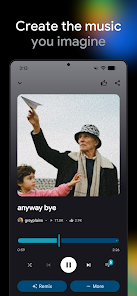
Images supplied with this app listing.
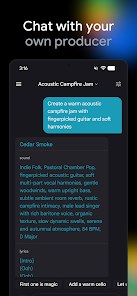
Google Flow Music is a prompt-led music creation app from Google Labs. Its Google Play listing describes turning lyrics or an instrumental idea into a full song, then refining the result through a conversational Producer. You can ask for changes such as stronger bass or a different vocal tone, remix uploaded audio, and build an AI music video with Veo. It is not simply a streaming player. The product website says it is free to start and mentions daily credits, so a new user should not assume that generating an unlimited number of tracks is free. Commercial rights and the treatment of uploaded audio also deserve a check in the current terms before serious use.
Start with a musical brief, not only a genre word
The store invites you to begin with lyrics or a simple instrumental track. A useful first prompt states the job of the music: for example, a restrained background for a tutorial, an energetic opening for a short video, or a vocal demo with room for a lead melody. Add a tempo feel, instrumentation, or mood only where it helps that purpose. Google Flow Music's site describes a Producer conversation rather than a one-shot text box, so you can listen to an initial result and request a specific change instead of rewriting the entire brief.
Its official examples include asking to make the bass punchier or to sing in a deeper voice. Those are concrete production directions. A broad request such as “make it better” is harder to evaluate because you have not said what was missing. Compare a short section before and after a revision and keep the version that serves the intended scene. The Google Play listing says the tool can generate full-length songs, but it does not promise that every prompt will produce exactly the arrangement you imagined.
Remix, replace, extend, and use your own audio carefully
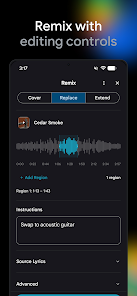
Google describes Covers, Replace, and Extend tools for remixing tracks. The names suggest different editing intentions: changing a take's style, replacing a portion, or building beyond the current ending. The listing does not publish a complete technical specification for what each control preserves, so inspect the result rather than assuming that a vocal, melody, or timing will remain identical. If you upload your own recording, keep an untouched local copy before experimenting.
The app is also marketed as a place to change vocals and vibe. That can be useful for comparing possible directions before a final recording, but it raises a rights question when the upload contains someone else's performance. The visible Google Play description and landing page do not grant a blanket license to remix any commercial song or use a generated imitation of a real artist. Use material you own or are allowed to transform, and read the current product terms for release and commercial-use rules before publishing a track.
Spaces and music videos are separate creative paths
“Spaces” are not just folders for finished songs. Google says users can build small audio tools such as custom plugins, music games, or personalized digital audio workstations and share them for others to use or remix. The public site gives a miniature keyboard as an example. That makes Spaces a more experimental area than the main Producer conversation. A beginner can ignore it at first, while someone with a specific workflow idea can explore whether an existing Space solves a repetitive task.
For visual output, the app description says a Veo model can create music videos alongside a track. The official site emphasizes control over characters and aesthetics. That is not the same as editing footage you filmed yourself. If you already have clips and need precise cuts or sound mixing, Adobe Premiere: Video Editor is a different kind of tool. Flow Music is the clearer experiment when the starting point is a generated song and you want model-created visuals to match it. Confirm current credit costs before planning a long sequence of revisions or renders.
Creation credits, downloads, and listening
The website says “free to start” and “no credit card required,” and it also names daily credits. Its headline says unlimited downloads, which should not be confused with unlimited free generation: downloading an existing result and creating a new one are different actions. The public information we checked does not establish a permanent number of daily credits or a fixed price for extra generation. Look at the account's live allowance before committing to a time-sensitive project.
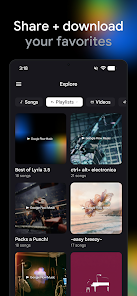
Flow Music also offers playlists, publishing, following artists, and discovery. Those are social and library functions around the generated tracks. Spotify is primarily a listening service with a vast catalog of released music and podcasts, while Flow Music is presented as a creation studio and a place to share what users make there. A person who only wants to play familiar recordings should not install a generative app expecting it to replace a conventional streaming subscription.
Questions to answer before using it for a project
Is Google Flow Music free?
The official website says it is free to start without a credit card and mentions daily credits. The public material does not give us a reliable permanent allowance for every account or region. Check your visible balance and current plan before assuming that an extended song, repeated remixes, or AI video generation will fit within the free tier.
Can I upload an existing track to remix?
Yes, the Google Play description says you can upload tracks and use remix functions including Covers, Replace, and Extend. It does not mean every upload is legally yours to transform or distribute. Keep an original copy, confirm you have the necessary rights, and review the output before sharing it publicly.
Does the app make a video as well as music?
The listing advertises music-video creation using Veo, with visual choices such as characters and aesthetics. Availability, generation cost, export limits, and model behavior can change. If the video is for a client or paid campaign, confirm the current terms and test a short concept before designing a production schedule around this feature.
Can I release a generated song commercially?
The store description and public landing page we reviewed do not provide a simple blanket answer covering every prompt, upload, and output. Do not infer commercial permission from the ability to download or publish a song inside the service. Read Google's current Flow Music terms and the rights to any uploaded audio before a commercial release.
What is a Space?
Google presents Spaces as shareable mini-apps for audio work: examples include a plugin, music game, or personalized DAW. This is distinct from the normal prompt-to-song Producer flow. It may be useful to a creator with a repeatable process, but a first-time user can make and refine a track without building one.
Our take on the fit
Flow Music is most interesting for someone who wants to iterate on a musical idea in conversation, try a remix, and possibly attach model-generated visuals. Its boundaries matter: daily credits are mentioned, commercial-use rights require checking, and the public pages do not guarantee a particular output from each prompt. A creator who needs deterministic editing of recorded footage or licensed catalog playback should use a purpose-built editor or music service instead. This assessment is based on Google's published product information, not a hands-on test of the generation quality.
Official sources: Google Flow Music on Google Play and Google Flow Music website.