ASL Lessons: Learn & Practice
App preview
Images supplied with this app listing.
ASL Lessons: Learn & Practice is an Android learning app from Fableso, first released on Google Play on October 15, 2026. It teaches American Sign Language through short sign videos, recall questions, organized units, and a video dictionary. A beginner can watch a sign, repeat it, and test recognition instead of trying to learn movement from a still picture. The important limit is that an app can help build vocabulary but cannot by itself confirm that your signing is understood in a real conversation. Installation is free, while full access is offered through an auto-renewing subscription after a three-day trial.
What the video-first lessons teach
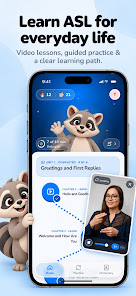
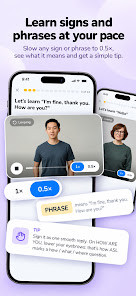
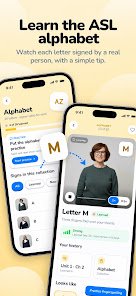
Fableso says each sign is shown in a video with an explanation and can be replayed at your own pace. That matters for a visual language: hand movement, direction, and timing are easier to observe in motion than in a written word list. Units and chapters provide a route from first vocabulary toward signed sentences. The public description does not publish the full syllabus, total number of signs, or independent curriculum review, so do not assume the app alone covers every conversational or regional variation of ASL.
The learning path is described as adapting to a goal such as communicating with a Deaf friend or family member, using signs at work, or learning with children. That is a useful way to choose relevant starting material, but the listing does not disclose exactly how the personalization algorithm selects lessons. When starting, pick the goal that matches an actual situation, complete a short unit, and try to recall its signs away from the screen. If a lesson feels familiar only while watching the video, replay it and then practice producing the sign without the prompt.
Recognition questions are not the same as conversation
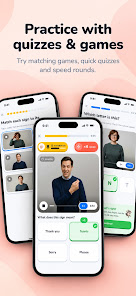
After a learn screen, the app advertises several question types: watch a sign and choose its meaning, pair words with signs, select a video for a word, and fill a missing word in a signed sentence. These are different retrieval tasks, not just repeated multiple-choice labels. A practical study routine is to answer a question, explain why the other choices are wrong, and revisit the sign a day later. This advice follows general study principles; we have not measured learning gains from this specific app.
Recognition is only one side of language use. The store does not claim live feedback on your own handshape, facial expression, or timing. Passing an app question therefore should not be treated as proof that a Deaf signer will understand you in a conversation. If your purpose is communicating with a particular person, ask for feedback from that person when welcome, or seek instruction from a qualified ASL teacher or Deaf-led course alongside app practice. Do not use a quick dictionary lookup as a substitute for understanding context and grammar.
When the dictionary is useful
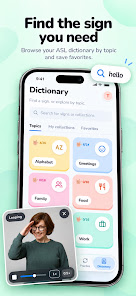
The built-in ASL dictionary lets users look up a word and watch its sign video. That can be valuable when a term from a lesson has slipped your memory or when you want to prepare vocabulary for an upcoming conversation. It is less reliable as a real-time translation plan: a spoken or written English sentence is not automatically an ASL sentence with each word replaced one by one. The listing does not promise sentence translation or a comprehensive account of regional variants.
Use the dictionary as a reference, then return to a full lesson or a person who can explain how a sign fits the intended meaning. For example, write down a few words you need at work, watch their videos, practice the movement, and check whether the phrase as a whole is appropriate before using it in a high-stakes interaction. The app may be a convenient starting point, but the public listing does not document the linguistic qualifications of its content creators.
How this differs from familiar language apps
Duolingo is designed around many language courses and short, gamified exercises. ASL Lessons has a narrower goal: videos of a visual language, sign-recognition drills, and a sign dictionary. If ASL is your specific learning objective, that specialization is relevant. It does not mean Fableso's curriculum has been independently proven more effective, nor does it turn a video lesson into a live class.
Google Translate serves quick text and speech translation needs across supported languages. The Fableso app is not advertised as a general translation utility; its value is structured practice and a visual reference for ASL signs. Someone needing an immediate conversation aid should not assume that a sign-learning app can interpret a live exchange. Someone trying to build repeatable signing knowledge may prefer the lesson-and-review format to a one-off translation lookup.
Trial, subscription, and Android compatibility
Google Play lists the app as free to install with in-app purchases. The developer describes an optional subscription that unlocks all lessons and features, with weekly, three-month, and yearly plans. Each plan starts with a three-day free trial and renews automatically unless canceled before the period ends. The current price can differ by plan, region, and promotion, so read the checkout screen before starting a trial. Use Google Play's Payments & subscriptions section to manage or cancel it; deleting the app should not be treated as the cancellation step.
At the October 22, 2026 check, the store listed version 1.0.1, an October 19 update, Android 7.0 or later, and an Everyone content rating. The original release date is October 15, not the later update date. Device compatibility can still vary even if the Android version meets that minimum. The public description does not clearly promise offline videos, a free lesson count, or whether every dictionary entry remains available without Premium, so verify the exact access you need during the trial before it renews.
Account and privacy questions
Google Play's developer-provided data-safety section says the app may collect and share personal and financial information along with other data types, and that data is encrypted in transit. It also says users can request deletion. These statements are disclosures, not an independent privacy audit. The public store page does not explain every account requirement or whether lesson videos are processed locally. Read the current privacy policy and permission prompts before entering personal details, particularly if a child will use the app.
Common questions before starting ASL Lessons
Is this app for American Sign Language specifically?
Yes. Its official name and description specifically refer to ASL, which the developer places in the United States and Canada. It is not advertised as a universal dictionary for all national sign languages. If the people you hope to communicate with use another sign language or a regional variety, check that need first rather than assuming the same signs apply everywhere.
Can it tell me whether I sign correctly?
The listing promises video examples and recognition questions, but does not promise camera-based assessment or live teacher feedback on your own signing. Watching and selecting the right answer can improve familiarity, yet it does not prove that your handshape, movement, and facial expression are clear. Use feedback from an appropriate teacher or conversation partner when accuracy matters.
How does the three-day free trial work?
Fableso says each weekly, three-month, or yearly subscription plan begins with a three-day trial and then renews automatically unless canceled before the period ends. The exact charge appears in the Google Play checkout flow. Set a reminder before renewal if you only want to evaluate the content, and cancel through Google Play Payments & subscriptions rather than simply uninstalling the app.
Does the dictionary translate whole English conversations?
The advertised dictionary lets you search a word and watch a sign video. The store does not claim live interpretation, full-sentence translation, or feedback about context and grammar. Use it to review vocabulary and then check how a phrase is actually expressed in ASL through a lesson or qualified instruction. Word-for-word substitution may not communicate the intended idea.
Can I learn without paying?
The app is free to install, but the developer says a subscription unlocks all lessons and features. The public description does not give a dependable list of what remains free after a trial. During the three-day period, inspect the units and dictionary entries you actually need, then decide whether the current plan and renewal price suit you.
Our take on the choice
ASL Lessons is worth considering if you want brief video-led practice and a dictionary focused on American Sign Language. Its most useful pattern is to watch, recall, and review a sign in context rather than collect a streak of correct taps. The subscription cost, unclear post-trial free access, and absence of advertised feedback on your own signing are reasons to pair it with a real learning community when possible. This is an assessment of Fableso's published features, not a claim that we completed the course or tested its teaching outcomes.
Official source: ASL Lessons: Learn & Practice on Google Play. Store details were checked October 22, 2026.