DropLearn: Daily Microlearning
App preview
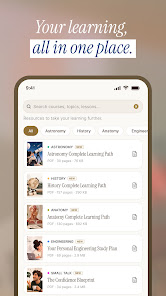
Images supplied with this app listing.
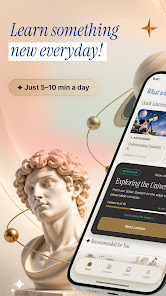
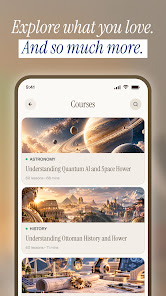
DropLearn: Daily Microlearning is an Android education app from Ocean Float Mobile that combines ordered video courses with a library of beginner-oriented ebooks. Its subjects range from engineering and astronomy to anatomy, physics, chess, art, history, and conversational small talk. The clearest course structure published by the developer is 60 videos per video course; each is intended to build on the previous lesson. That can help someone who wants a route through a topic rather than a random feed of short facts. Google Play lists in-app purchases, however, and the public description does not specify exactly how many lessons or books remain free. Check the paywall before depending on it for a study plan.
Choose a subject with a concrete goal
“Learn something every day” is too vague to tell whether an app helped. DropLearn's catalog is broad enough to support a narrower choice. If you are curious about the night sky, begin with the astronomy path and decide whether you want video explanations or its companion ebook. If you need to review basic physical laws for a class, use the physics reading path and compare it with your syllabus. If your aim is social confidence, the Small Talk book is a different kind of practice from memorizing facts about anatomy. The publisher does not claim accreditation or a recognized qualification, so use the app as learning material, not as a substitute for a formal course when credentials matter.
The listing describes the books as “zero to advanced,” but does not publish full tables of contents or assessment standards. A label of advanced does not establish college-level depth. Open the first available chapter, inspect the explanations and examples, and see whether the later chapter list covers the questions you actually have. For scientific or medical subjects, verify consequential claims against a textbook or qualified source. The app may make exploration convenient; it cannot by itself certify mastery.
How the video courses are organized
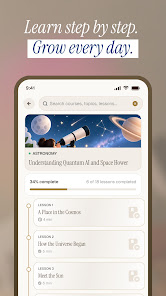
Ocean Float Mobile says each video course contains 60 lessons in sequence. The Google Play description specifically names engineering and astronomy video paths. That order is useful when one concept depends on another: starting at the beginning can prevent a later term from seeming mysterious. A practical routine is to watch one lesson, explain its main idea without looking, and then return to the part you could not explain. The store does not advertise a built-in quiz or spaced-repetition scheduler, so do not assume the app performs that checking for you.
“Microlearning” suggests a small daily session, but the publisher does not state that every video has the same duration. Check a course's actual lessons before committing to a fixed five-minute plan. If the material becomes too dense, pause and use the ebook version where one exists. That gives you a way to reread a definition or diagram rather than replaying an entire video. The listing says you can pick up where you left off, but it does not detail cross-device synchronization or offline downloads; avoid promising either without confirmation in the current build.
What the ebook library covers
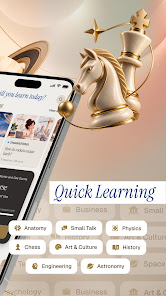
DropLearn names Anatomy, Physics, Astronomy, Engineering, History, Art, Chess, and Small Talk as reading subjects. These topics need different types of practice. For anatomy, sketch the relationship between organs and systems after reading a section. For chess, take an opening or tactic from the book to a board and check whether you can recognize the idea in another position. For art history, compare the style being described with an image from a trustworthy museum collection. For small talk, an example conversation is useful only if you try a respectful version of it in real life. These are ways to apply the advertised reading material, not claims that the app supplies those exercises or resources.
The app's “zero to advanced” language describes the publisher's intended progression across each book. It does not tell us whether a reader receives citations, exercises, certificates, or instructor feedback. A student preparing for an exam should compare a sample book chapter with the required curriculum before paying. A casual learner can be more flexible: if one topic is too superficial, another in the same library may still be worth exploring. The range is the convenience; the depth of each title remains something to inspect individually.
Free download versus paid access
Google Play shows DropLearn as free to install with in-app purchases. It does not make a complete price, trial, renewal, and access matrix clear in the listing text reviewed. Two recent user reviews report a paywall after a brief free period, one describing three days, but those are individual accounts rather than official plan terms. Do not treat either review as a guarantee of the current trial. Before starting any trial, read the offer sheet inside the app for the exact price, billing interval, renewal date, cancellation path, and what remains available without payment. Keep a record of the terms you accept.
The developer's general website says little about DropLearn specifically, so it cannot settle the access question. If a course is needed for a deadline, first confirm whether the full 60 videos and relevant ebooks are included in the plan offered to you. A lesson list may be visible while actual playback is restricted. If the cost is uncertain, begin with a free sample and compare alternatives before entering payment details. Google Play's purchase controls, not an app-review article, govern a particular transaction and refund.
Data and study expectations
The Play data-safety panel says the app may collect and share app activity, app information and performance, and device or other identifiers. It says data is encrypted in transit. These are developer-provided disclosures, not an independent audit. The public description does not establish whether you need an account for every feature, whether reading progress is portable, or whether videos can be saved offline. Test those points with a free lesson if they matter to you. If you study on a limited data plan, confirm video usage and download controls before streaming a whole course.
DropLearn is not the same as a language-practice app. Duolingo focuses on language exercises, while ASL Lessons: Learn & Practice is specific to sign-language videos and recognition. DropLearn's breadth may be attractive when you want to sample science, art, and practical skills in one place; specialization may be better when you need repeated feedback in one discipline.
Questions before starting a course
Are all 60 video lessons free?
The store advertises 60 lessons per video course, not 60 free lessons. Google Play flags in-app purchases, and the public description does not list which videos are unlocked without paying. Check the current in-app offer and try a lesson before planning a long study path. Do not interpret a visible lesson title as proof of free playback.
Can I study without internet access?
The official store text does not confirm offline video or ebook downloads. Because online video courses are central to the app, assume you need to test connectivity before relying on it during travel. If offline study is essential, look for a clearly documented download control in the current app and verify that a lesson opens in airplane mode before paying.
Will DropLearn award a certificate?
No certificate or accreditation is promised in the reviewed Google Play description. It presents educational videos and books, not a credentialing program. Use it to explore or review ideas; ask a school, employer, or licensing body what proof they require before substituting the app for an approved course.
How should a beginner use the broad catalog?
Pick one concrete question and one subject first. Follow the ordered video course if you want a guided path, or open the corresponding ebook if you need to reread at your own pace. After a few lessons, explain what you learned without the screen and compare that explanation with another reputable source. Switching subjects each day may feel varied but can make it harder to build on previous lessons.
Our take on DropLearn
DropLearn's strongest documented feature is structure: 60 ordered videos for a course, plus ebooks that begin with foundations across a wide catalog. Its biggest purchase caveat is that the public store description does not clearly identify free-tier boundaries or the current trial terms. Students who need assessed learning, verified depth, or offline access should check those points before relying on it. This is an assessment of the publisher's documented content and Google Play disclosures, not a hands-on judgment of lesson quality or a promise of learning outcomes.
Official source: DropLearn on Google Play. The developer's general website was also checked October 22, 2026; it does not provide a DropLearn-specific plan comparison.