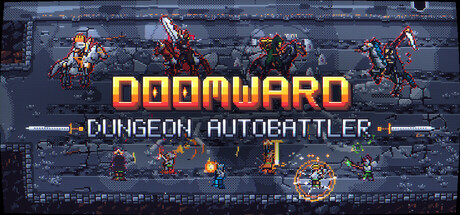
Doomward: Dungeon Autobattler
- Developer
- Mire Studios
- Publisher
- Mire Studios
- Release date
- Oct 21, 2026
Screenshots
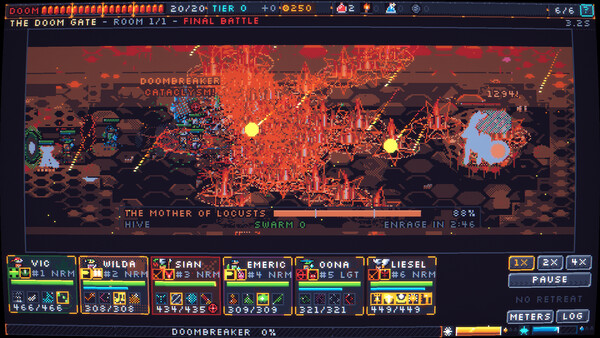
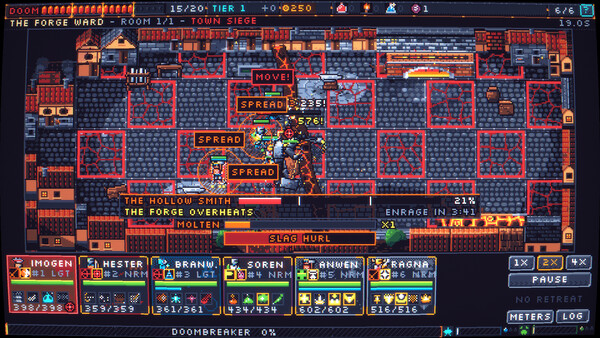
Screenshots supplied with this Steam listing.
Doomward: Dungeon Autobattler is a paid Windows roguelike strategy game first released on Steam on October 21, 2026. Battles resolve automatically; your meaningful choices happen before and between them. You hire and specialize heroes, borrow abilities from other classes, assign rules for targeting and item use, then send a party along a branching expedition. Death is permanent and a Doom Clock threatens your town. It suits players who enjoy designing a plan and watching whether it survives contact with enemies. It is not a reflex action RPG where you personally swing each weapon.
Winning a fight before it starts
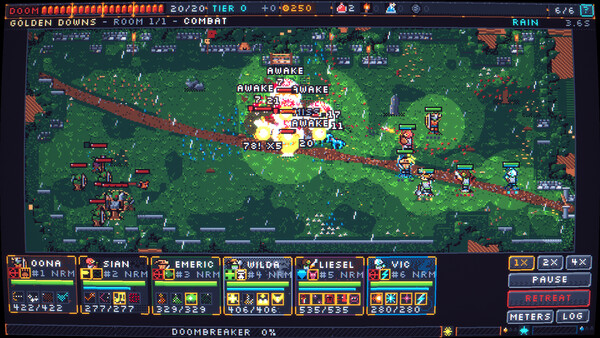
The developer's central promise is explicit: “you never swing a sword.” Heroes carry out orders according to the rules you set. You decide who they should target first, when to hold a major spell, and when to drink a potion. A party that has strong individual units but poor timing can still fail. For example, spending a high-impact ability on a nearly defeated minor enemy may leave nothing for a dangerous target. The store does not list every condition available in its rule editor, so learn the current interface rather than assuming it offers a full programming language.
Class selection and specialization shape what a hero can do. The public description also says you can lend abilities borrowed from other classes, expanding the build space beyond a fixed class tree. Start by making the party's basic jobs clear: who absorbs danger, who applies a useful state, who converts that state into damage or control, and who restores or protects the group. This is a planning framework drawn from the advertised combo system, not a claim that one composition is mathematically optimal in the released game.
States and combinations are the real combat verbs
Doomward gives concrete examples of chained effects. Chill can lead to freeze and then shatter. Oil can be applied to a group before fire ignites it. These sequences matter because an automatic battle cannot rely on a player manually correcting every mistimed move. The order in which heroes act and the conditions in their rules may decide whether a combo happens at all. When a fight goes badly, inspect the sequence rather than only comparing damage totals. Was oil applied after the fire user acted? Did a frozen target die before the shatter effect could matter?
The store does not publish exact damage multipliers, state durations, resistance values, or the entire class roster. A useful guide therefore explains the dependency between effects without fabricating numbers. Change one rule or one hero at a time and observe whether the intended chain occurs more often. Permanent death makes reckless experiments costly in a run, so test a new interaction on a manageable encounter before relying on it against the final boss.
The Doom Clock turns routes into trade-offs
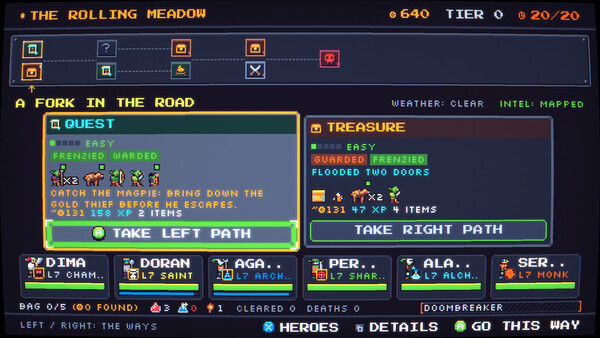
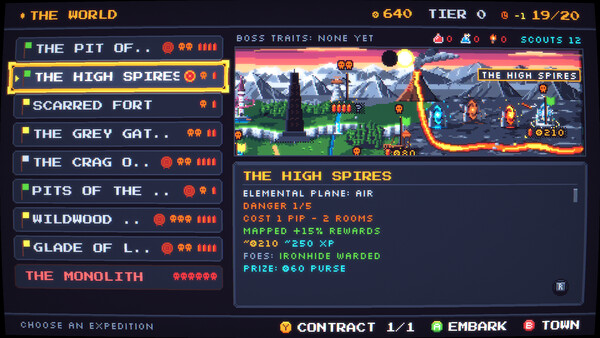
Every expedition costs Doom. The world map offers forks with distinct weather, traps, and foes, as well as guarded vaults, quests, and riskier uncharted doors. A detour may offer stronger loot or a contract payout, but spending too much time allows Harbingers to besiege your town. If the town loses that siege, the run ends. The clock is not only a score display; it is pressure against taking every tempting branch. Contracts also let you bet on an expedition's outcome, adding another reason to weigh expected reward against risk.
Before choosing a route, ask whether the next reward solves a real weakness. A guarded vault is less attractive if it gives gear the current party cannot use, while a safer quest may preserve enough time to reach the Monolith. The public description does not provide a precise cost for each road, so compare the visible options in the game. An uncharted door promising more reward is not necessarily a better choice when the town is already close to a siege.
Monolith boss and the Doombreaker
When the clock expires—or when you decide the party is ready—you climb the Monolith to face the Herald. The developer describes a phased raid boss with telegraphed attacks, additional enemies, and enrages. Your heroes must answer those events using their prearranged rules. Hits, kills, and fallen allies charge a party ultimate called the Doombreaker. The particular response is described as subject to fate, so treat it as a powerful resource with uncertainty, not a guaranteed escape from a poor build.
This creates a meaningful preparation question: has the party been built only for short skirmishes, or can it survive a changing multi-phase encounter? A combo that wipes ordinary enemies may be weak against a durable boss or adds that arrive at the wrong time. Consider rules that conserve major spells when a lesser target is about to fall. The store does not document the Herald's exact phase thresholds, so no honest first-release article can claim a tested phase-by-phase script.
Co-op, rival runs, and the arena
The game supports two to four players in co-op. According to the official description, everyone shares one Doom Clock and map, each controls a guild, fights are shared, and road choices are made by vote. That means group planning matters before a battle even begins. Rival runs put one-versus-one or two-versus-two parties through the same seed and clock before a final party fight. The PvP Arena separately offers one-versus-one and two-versus-two drafting, blind bids for gear, and a best-of-five format.
Steam online play, LAN, and direct connection are listed. Daily Doom and Weekly Doom give everyone a shared seed with leaderboard competition, while optional Edicts modify a run for a higher score. These are distinct ways to play, not proof that matchmaking populations will always be available. A buyer focused on PvP should check current player activity and connection requirements. Risk of Rain 2 also offers repeatable runs, but its moment-to-moment combat is directly controlled; Doomward shifts agency toward builds and instructions. We Were Here Tomorrow demands co-op communication for puzzles rather than party automation.
Controller and PC considerations
The developer advertises a dedicated controller interface with remappable buttons and prompts for several controller families. It also says the interface works on Steam Deck. That is a developer claim about the UI, not a verified Valve Deck compatibility rating or a performance benchmark. The reviewed Steam platform list includes Windows, not native macOS or Linux. Minimum PC requirements are 64-bit Windows 10, a dual-core 2.0 GHz processor, 4 GB RAM, DirectX 11-compatible graphics, broadband internet, and 200 MB storage. The publisher recommends stronger hardware for its higher settings.
The minimum's broadband line should be taken seriously if you plan co-op or leaderboard runs. It does not clarify whether a fully offline single-player mode is available, so do not assume one. Steam Cloud and achievements are listed in the description, but neither replaces your own backup if a save matters. Price, regional availability, and refund terms should be checked in your Steam storefront at purchase time.
Questions before hiring the party
Can I control a hero during combat?
The developer explicitly describes combat as automatic. You build heroes, equip them, borrow skills, and write rules governing their actions, then watch the fight resolve. If you want direct movement, dodging, or attack input, this is likely the wrong combat format. The interesting decisions are composition, conditional behavior, route selection, and when to risk permanent losses.
Is death permanent?
The official page says death is permanent and there are no revives. Treat party members as investments in a run, not expendable pieces you can always restore after a failed battle. The text does not describe every possible meta-progression rule between runs, so do not infer that all unlocked progress vanishes with one fallen hero.
Can friends share an expedition?
Yes. Co-op is advertised for two to four players, with a shared clock and map, each player's guild, shared fights, and votes on the next road. Online through Steam, LAN, and direct connection are listed. The reviewed text does not guarantee cross-platform play or describe how late joining works, so confirm those details in the current multiplayer menu.
Does the Steam Deck claim mean verified status?
No. The developer says its controller interface works on Steam Deck, with remappable inputs and several prompt styles. That is useful information but not the same as an independent performance or compatibility test. Check the live Steam Deck status and current user reports if handheld play is your main reason to buy.
Our take
Doomward's sharpest idea is making automatic combat accountable to rules you wrote yourself. The Doom Clock then asks whether a clever party can take one more rewarding detour without losing the town. Its risk is that the satisfying action is mostly analytical: players who need to steer every fight may not enjoy watching a plan play out. This is an editorial reading of the official feature list, not a claim that we reached the Herald or tested balance.
Official source: Doomward: Dungeon Autobattler on Steam, including its October 21 launch news. Checked October 22, 2026.
System requirements
WindowsMinimum
- Requires a 64-bit processor and operating system
- OS: Windows 10 64-bit
- Processor: Dual-core, 2.0 GHz
- Memory: 4 GB RAM
- Graphics: DirectX 11 compatible
- DirectX: Version 11
- Network: Broadband Internet connection
- Storage: 200 MB available space
Recommended
- Requires a 64-bit processor and operating system
- OS: Windows 10 / 11 64-bit
- Processor: Quad-core, e.g. Intel Core i5-2500K / i7-2600K or AMD FX-6300
- Memory: 8 GB RAM
- Graphics: DirectX 12 or Vulkan 1.1 GPU, e.g. GeForce GTX 750 / Radeon R7 260X / Intel HD 620
- DirectX: Version 12
- Network: Broadband Internet connection
- Storage: 200 MB available space
Check the current Steam listing for the latest platform-specific requirements.
Game information
- Title
- Doomward: Dungeon Autobattler
- Category
- Simulation
- Developer
- Mire Studios
- Publisher
- Mire Studios
- Release date
- Oct 21, 2026
- Platforms
- Windows
- Steam App ID
- 5364850
- Official store
- Steam